Rough Doodle Pack: A Versatile Resource for Designers and Creators
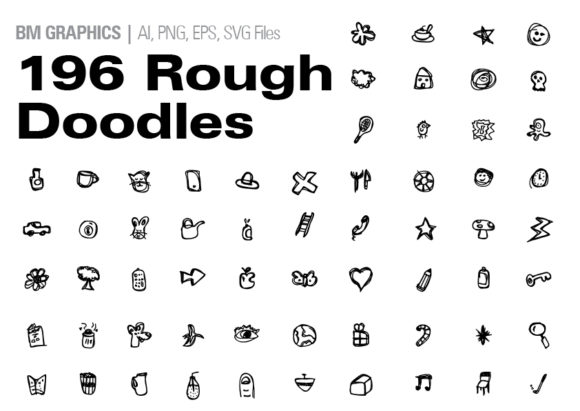
The Rough Doodle Pack offers a unique blend of simplicity and utility, making it an appealing choice for designers, illustrators, and creative professionals who need quick graphic elements without the complexity of detailed artwork. With over 190 rough doodles included, this collection is designed to provide flexibility across various design applications. Whether you're working on branding materials, website visuals, or print projects, the Rough Doodle Pack provides a range of stylized icons, web assets, and graphic elements that can be adapted to fit different contexts.
What Makes the Rough Doodle Pack Stand Out?
The core strength of the Rough Doodle Pack lies in its emphasis on simplicity and adaptability. Unlike highly detailed illustrations that may require extensive customization, these rough doodles are intentionally loose and hand-drawn, giving them a more organic feel. This makes them ideal for projects where a casual, sketch-like aesthetic is desired.
One of the key features of the pack is the variety of file formats it supports. It includes four popular file types: EPS, Ai, PNG, and SVG. This versatility ensures that users can integrate the doodles into both digital and print-based workflows with ease. For example, EPS and AI files are excellent for high-resolution printing, while PNG and SVG formats are well-suited for web use and scalable graphics.
Comparing the Rough Doodle Pack with Similar Resources
When evaluating the Rough Doodle Pack, it's important to consider how it stacks up against other similar resources in the market. While many illustration packs focus on polished, finished artwork, the Rough Doodle Pack takes a different approach by emphasizing raw, sketch-like imagery. This distinction can be a significant factor depending on the project’s needs.
For instance, if you're designing a logo that requires precision and clarity, a more refined illustration set might be more appropriate. However, if your goal is to create a visual identity that feels more relaxed or playful, the Rough Doodle Pack could be a better fit. The decision ultimately depends on the tone and style you wish to convey through your design work.
Compared to some alternative resources that offer a broader range of styles, the Rough Doodle Pack maintains a consistent aesthetic. This can be both a benefit and a limitation. On one hand, it ensures that all doodles share a cohesive look, which can streamline the design process. On the other hand, it may not be as suitable for projects requiring diverse visual elements.
Best-Fit Situations for Using the Rough Doodle Pack
The Rough Doodle Pack excels in scenarios where a minimalist or casual design language is preferred. It's particularly useful for creating mockups, wireframes, or concept sketches where the focus is on ideas rather than final presentation. Additionally, the wide array of doodles allows for quick experimentation with different icon sets or graphic elements without the need for custom illustration.
For example, a web designer working on a portfolio site might use these doodles as decorative elements or background graphics to add visual interest without overwhelming the layout. Similarly, a marketing team developing social media content could leverage the pack to create engaging, eye-catching visuals that align with a brand’s more informal tone.
In contrast, for projects that demand intricate details or a professional finish, the Rough Doodle Pack may not be the best option. In such cases, investing in a more specialized illustration resource or hiring a freelance illustrator might be necessary.
Evaluating Tradeoffs and Limitations
No single resource is perfect for every situation, and the Rough Doodle Pack is no exception. One potential limitation is that the rough, hand-drawn nature of the doodles may not be suitable for all design contexts. For instance, if you're creating a technical diagram or a data visualization, the stylized look of these doodles could interfere with readability or clarity.
Another consideration is scalability. While SVG files are vector-based and can scale without losing quality, the rough lines and textures inherent in the doodles may become less defined when enlarged beyond a certain point. This means that using the pack for large-format prints or billboard designs might require additional refinement or layering.
Additionally, the lack of color variations in the base set could be a drawback for users looking for ready-to-use colored illustrations. However, this also presents an opportunity for customization—users can easily recolor the doodles using their preferred tools to match specific branding guidelines or design themes.
Practical Use Cases and Real-World Applications
To illustrate the practicality of the Rough Doodle Pack, consider a scenario where a small business owner wants to refresh their website's visual identity. Instead of commissioning custom illustrations, they could use the doodles from the pack to create a cohesive yet dynamic look. By selecting relevant icons and integrating them into the site's navigation or call-to-action buttons, the overall design becomes more engaging without appearing overly polished or corporate.
Similarly, educators or trainers might find the pack useful for creating visually appealing presentations or infographics. The loose, sketch-like quality of the doodles can help break up dense text and make complex information more digestible. The ability to export in multiple formats also ensures compatibility with different presentation software and platforms.
In another context, a product packaging designer might use the Rough Doodle Pack to add subtle graphical elements to a label or box. These doodles can serve as decorative accents or thematic motifs without overpowering the main product imagery.
When to Choose the Rough Doodle Pack and When to Look Elsewhere
The Rough Doodle Pack is most effective when the goal is to add character, texture, or a sense of spontaneity to a design. It works well for projects that prioritize creativity and visual storytelling over strict realism or technical accuracy.
However, if your project requires a high level of detail, consistency in style across multiple illustrations, or a more formal appearance, you may want to explore other options. Some alternatives include premium illustration packs, vector graphic libraries, or even hiring a freelance artist for custom work.
Ultimately, the decision to use the Rough Doodle Pack should be based on the specific requirements of your project. If the loose, hand-drawn aesthetic aligns with your vision and the available doodles meet your needs, then this pack could be an excellent addition to your design toolkit. Otherwise, exploring other resources may be more beneficial in the long run.